ChatGPT vs Gemini vs Claude for SEO: Which AI Wins in 2026?
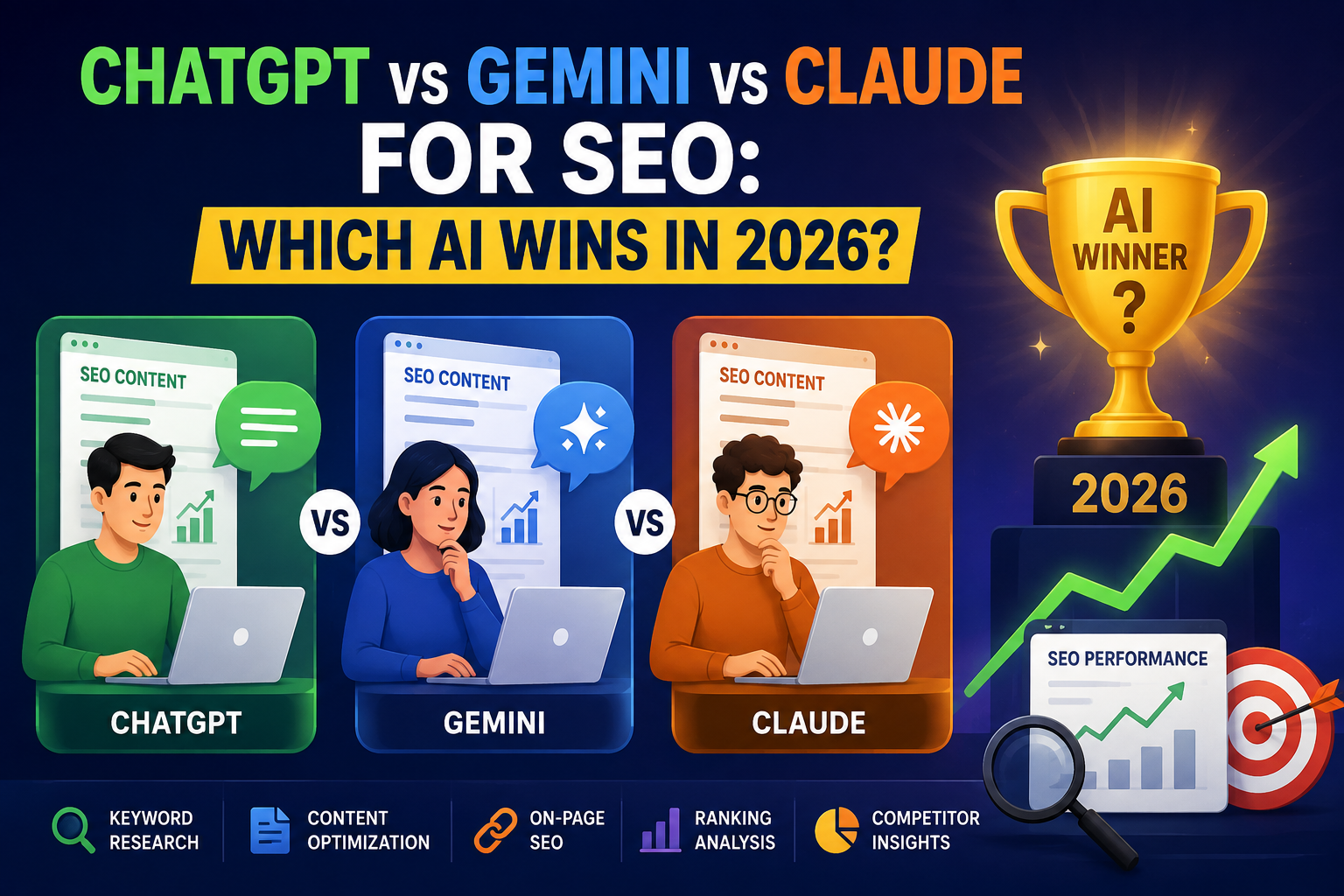
ChatGPT vs Gemini vs Claude for SEO – Every SEO team now has at least one AI assistant open in a browser tab, and most have three. The honest problem isn’t whether to use AI for SEO anymore it’s which model to reach for when.
ChatGPT, Gemini, and Claude are all genuinely capable, but they aren’t interchangeable, and picking the wrong one for a specific task tends to show up later as flat, repetitive content or a missed research angle.
This guide breaks down ChatGPT, Gemini, and Claude specifically for SEO work keyword research, long form writing, research and fact checking, and visibility inside AI Overviews with a clear task by task verdict for marketers and bloggers in the US and UK who need a straight answer, not a spec sheet comparison.
Why This Comparison Matters More Than Ever in 2026
SEO used to mean one thing: rank on Google. In 2026, it means two things at once ranking in traditional search results, and being cited inside AI generated answers on Google’s AI Overviews, ChatGPT, Gemini, and Perplexity.
That second goal has its own name, Generative Engine Optimization (GEO), and it changes which AI model actually matters most depending on what you’re trying to achieve.
Choosing between ChatGPT, Gemini, and Claude isn’t just about writing quality anymore. It’s also about which model powers the AI answer engine you’re trying to get cited inside, and which one produces content strong enough to earn that citation in the first place.
- ChatGPT: best for keyword brainstorming, clustering, meta titles, fast short form copy, and plugin based workflows
- Claude: best for long form SEO writing, tone consistency, editing, and large context content audits
- Gemini: best for real time research, current statistics, and content aimed at Google’s AI Overviews specifically, since Gemini is the model behind them
ChatGPT for SEO- Strengths and Best Use Cases
ChatGPT remains the most widely used AI tool in SEO workflows, largely because of its speed and flexibility. It’s strong at generating seed keyword lists, brainstorming long tail variations, and organizing keywords into topic clusters tasks that benefit from quick iteration rather than deep, sustained reasoning over one long piece of content.
Keyword Research and Clustering.
For the ideation stage of keyword research seed expansion, intent classification, and clustering ChatGPT is consistently the fastest of the three. It handles rapid back and forth refinement well, which matters when you’re narrowing down fifty keyword ideas into ten worth targeting.
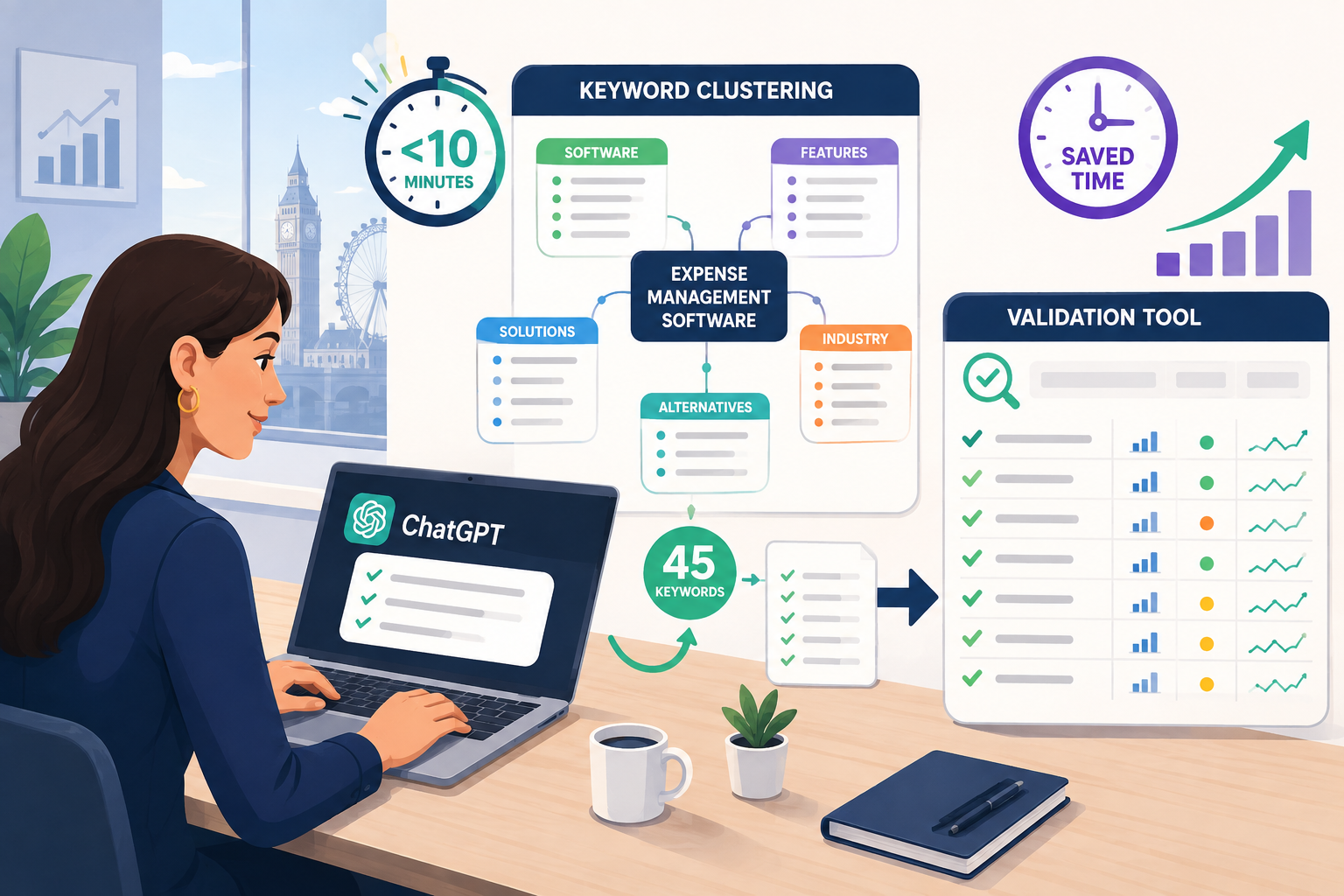
Real world example: A marketing manager at a UK-based SaaS company used ChatGPT to generate and cluster 45 keywords around “expense management software” in under ten minutes, then moved the shortlist into a validation tool a workflow that used to take her nearly an hour manually.
Meta Titles, Descriptions, and Short Form Copy
ChatGPT produces strong, punchy meta titles and descriptions quickly, and generally outperforms Claude on this specific task, since Claude’s writing style tends toward longer, more measured phrasing that doesn’t always fit a tight character limit as naturally.
Where ChatGPT Struggles
Past roughly the 2,000 word mark, ChatGPT’s long-form output can start to feel repetitive or lose the thread of a structured argument without strong, deliberate prompting to keep it on track. For a single long blog post, this often means more editing afterward than starting with Claude would have required.
ChatGPT’s Ecosystem Advantage
One area where ChatGPT pulls ahead regardless of writing quality is its ecosystem custom GPTs, plugin style integrations, and Actions that connect to other marketing tools.
For teams running High volume, semi automated content production (large batches of product descriptions or programmatic SEO pages, for example), this ecosystem often matters more than which model writes the single best paragraph.

Real world example: An ecommerce team managing over 300 product pages built a custom GPT workflow to generate first draft descriptions at scale, something that would have required a more manual, one-at a time process in Claude, which doesn’t offer the same plugin ecosystem.
Claude for SEO Strengths and Best Use Cases
Claude has become the preferred choice among serious content teams specifically for long form SEO writing. Its strength is structural coherence across a long piece maintaining an argument, varying sentence rhythm naturally, and integrating keywords without the piece starting to feel stuffed or mechanical.
Long Form Blog Posts and Articles
For anything over 1,500 to 2,000 words, Claude tends to hold structure and tone more consistently than ChatGPT, which is part of why it’s frequently the top pick for full articles, guides, and pillar content that needs less editing before publishing.

Real world example: A content agency in Austin switched their primary long form drafting tool from ChatGPT to Claude after noticing their editors were spending noticeably less time fixing repetitive phrasing and structural drift in Claude’s first drafts, even on articles well past 2,500 words.
Editing and Brand Voice Consistency
Claude is also frequently used specifically for editing existing content, since it tends to preserve an author’s original voice during a rewrite rather than flattening it into a generic AI tone useful for teams maintaining a consistent brand voice across many writers.
Large Context Content Audits
Because Claude can handle very large amounts of pasted text or data in one conversation without losing track of earlier context, it’s well suited to full site content audits, reviewing crawl exports, or working through an entire keyword list alongside content briefs in a single session.
Where Claude Struggles
Claude is generally considered weaker than ChatGPT specifically at short meta titles and descriptions, where ChatGPT’s punchier, more varied output tends to fit tight character limits more naturally. Claude also lacks the same plugin-style ecosystem for high-volume automated workflows.
Claude’s Citation Reliability
One underrated strength worth noting for research-adjacent SEO work: Claude tends to be notably careful about fabricating sources, often flagging uncertainty rather than inventing a confident sounding citation. For content that leans on statistics or studies, this reduces the risk of publishing a fact checked-sounding claim that turns out to be invented.

Real world example: A health content writer asked Claude to summarize a set of medical study findings for a wellness blog post, and it flagged which claims came directly from the source versus which were its own interpretation a distinction that mattered for a topic where factual accuracy carries real legal and reputational weight.
Gemini for SEO- Strengths and Best Use Cases
Gemini’s clearest advantage is real time research integration. Because it can pull current statistics, recent news, and up-to-date examples, it’s especially useful for trend pieces, news-adjacent content, or any article that needs to cite something that happened recently.
Research Heavy and Current Events Content
Real world example: Mr, John,A finance blogger writing about a recent interest rate change used Gemini specifically because it could pull the actual current rate and recent related news directly into the drafting process, saving a separate research step that ChatGPT or Claude would have required through a different tool.
Native Google Ecosystem Integration
For teams already working inside Google Search Console, Google Analytics 4, or Google Ads, Gemini’s proximity to those tools (where account integrations are set up) can streamline reporting and analysis tasks that would otherwise require exporting data elsewhere.
Why Gemini Matters Specifically for AI Overviews
This is the detail most comparison guides skip: Gemini is the model that powers Google’s AI Overviews and AI Mode. That doesn’t mean writing “with” Gemini guarantees a citation, but it does mean understanding how Gemini evaluates and summarizes content is directly relevant to earning a spot inside Google’s AI-generated answers specifically, as opposed to ChatGPT’s or Perplexity’s separate answer engines.
Where Gemini Struggles
Gemini’s prose quality for original content creation still lags behind Claude’s it tends to produce competent, well structured drafts that read as more functional than genuinely engaging, which usually means more editing for tone before publishing.
Common Mistakes When Choosing Between These Tools
Using One Tool for Every Task Out of Habit
The most common mistake is picking a favorite model early on and defaulting to it for everything, including tasks it isn’t particularly strong at drafting a 3,000 word guide entirely in ChatGPT, for instance, when Claude would likely require less post editing for that specific job.
Assuming Better Writing Automatically Means Better AI Visibility
Strong prose from Claude doesn’t automatically translate into being cited by Gemini-powered AI Overviews, since visibility there depends on a mix of traditional SEO signals and how thoroughly a topic’s sub questions are covered not purely on writing quality.
Ignoring Regional Differences in US and UK SEO Content
All three models can drift toward American spelling and phrasing by default unless told otherwise. For UK-targeted content specifically, explicitly requesting British English and UK-specific examples produces a noticeably more accurate result than leaving the region unspecified.
Task-by-Task Verdict
| SEO Task | Best tool | Why |
|---|---|---|
| Keyword research and clustering | ChatGPT | Fast iteration, strong at organizing large lists |
| Long form blog posts and guides | Claude | Structural coherence, natural keyword integration |
| Meta titles and descriptions | ChatGPT | Punchier phrasing within character limits |
| Editing and brand voice consistency | Claude | Preserves original tone during rewrites |
| Current events and trend-based content | Gemini | Real-time research integration |
| Content audits from large data exports | Claude | Strong large context handling |
| Optimizing for Google AI Overviews specifically | Gemini | Same underlying model powers AI Overviews |
| Fast social media captions and short copy | ChatGPT | Speed and platform-aware formatting |
How This Fits Into GEO and AI Overview Visibility
In Generative Engine Optimization, a click is no longer the only unit of value a citation is. The core question shifts from does this page rank to “does this page get named as a source when an AI model answers a related question.
That distinction matters because a page can perform very differently across AI engines a brand might be well cited on Claude or inside Google’s AI Mode while being nearly invisible on ChatGPT, or the reverse.
A few practical implications follow from this:
- Since Gemini powers Google’s AI Overviews, strong traditional SEO fundamentals still correlate most closely with visibility there, more so than with ChatGPT or Perplexity’s separate systems.
- Perplexity tends to generate citations more frequently than ChatGPT, but that also raises the odds of a competitor being cited instead of you for the same query, so tracking your visibility across more than one engine matters.
- Content that covers a topic’s full range of sub-questions thoroughly is more likely to be treated as a trustworthy source across all of these systems, since AI models generally read shallow coverage of a topic as a sign the source lacks real expertise.
- Being mentioned and discussed in places like Reddit threads or industry forums increasingly carries real weight for AI-generated “share of voice,” in a way that resembles how backlinks used to work for traditional SEO.
The practical takeaway is that tracking AI visibility now needs to happen across more than one engine, since a brand’s presence on ChatGPT, Claude adjacent citations, and Google’s Gemini powered AI Overviews can look completely different from each other. Treating any single engine’s citation rate as the full picture risks missing where the real gap actually is.
Which One Should You Actually Use?
For most individual bloggers and small marketing teams, the realistic answer is a combination rather than picking one exclusively. A workflow used by several agencies looks roughly like this.
brainstorm and cluster keywords in ChatGPT, draft and edit the long form article in Claude, and pull in Gemini specifically when the piece needs current statistics or a fact that changes month to month. which is a small expense next to the hours it replaces in manual research and editing.
Real world example: A five person content team at a UK fintech startup restructured their process around this exact split ChatGPT for the weekly keyword research session, Claude for drafting and editing every long form guide, and Gemini only when a post referenced a current interest rate or recent regulatory change.
Within two months, their average time to publish for a 2,000 word article dropped by roughly a third, mostly from cutting the editing time Claude’s first drafts required compared to their previous all ChatGPT process.
Frequently Asked Questions for ChatGPT vs Gemini vs Claude for SEO: Which AI Wins in 2026?
Which is best Ai Tool among ChatGPT vs Gemini vs Claude for SEO in 2026?
There isn’t a single winner across every task Claude is generally strongest for long form writing that needs to rank, ChatGPT is fastest for keyword research and short form copy, and Gemini is most relevant specifically for optimizing toward Google’s AI Overviews, since it’s the model behind them.
Which is best Claude vs ChatGPT vs Gemini for content creation in 2026?
If you want one AI for every type of content, ChatGPT is the most versatile choice. It handles blog posts, SEO content, marketing copy, and creative writing well.
- Claude: Best for long-form, natural-sounding articles with strong structure.
- ChatGPT: Best all-around for SEO, content creation, brainstorming, and editing.
- Gemini: Best when your content needs up-to-date web information and Google ecosystem integration.
Choose Claude for polished long-form writing, ChatGPT for overall content creation, and Gemini for research heavy or current topic content.
Is Claude better than ChatGPT for SEO content writing?
For the actual writing of long form SEO content tone, structural coherence, and readability Claude is generally considered stronger due to its context retention and more natural instruction following. ChatGPT remains stronger for fast keyword research, clustering, and short form copy at volume.
Does Gemini have an advantage for ranking in Google specifically?
Yes, indirectly. Because Gemini is the model behind Google’s AI Overviews and AI Mode, understanding how it evaluates and summarizes content is directly relevant to earning visibility inside those specific Google features, separate from ChatGPT’s or Perplexity’s own answer systems.
Can I use all three AI tools together for one SEO workflow?
Yes, and many marketing teams already do. A common pattern uses ChatGPT for keyword research and ideation, Claude for drafting and editing long form content, and Gemini for real time research or content tied to current events assigning each tool to the task it handles best rather than relying on one model for everything.
What is Generative Engine Optimization and how does it relate to this comparison?
Generative Engine Optimization, or GEO, is the practice of structuring content to be cited inside AI-generated answers, rather than only aiming for a traditional search ranking. Since ChatGPT, Gemini, and Claude each power different AI answer systems, understanding their individual strengths also affects which platforms your content is more likely to be surfaced on.
Do I need a paid plan for any of these tools to do SEO work effectively?
Free tiers of ChatGPT, Gemini, and Claude can all handle a meaningful share of everyday SEO tasks, particularly keyword brainstorming and short content pieces. Paid plans generally become worthwhile once you need higher usage limits, longer context windows for large audits, or advanced integrations with tools like Google Search Console or Analytics.
Which AI model should a small business with limited budget start with?
For a solo blogger or small business testing the waters, starting with ChatGPT’s free tier is usually the most practical choice, since it covers keyword research and short form copy without any cost.
Claude is worth adding once long form content quality becomes the main bottleneck, and Gemini becomes more valuable once a business already depends on Google Workspace or Google Ads for other parts of its operations.
How often should this comparison be revisited, since AI models update frequently?
Model capabilities shift often enough that a comparison like this is worth revisiting every three to six months. A tool that struggles with a specific task today may improve significantly within a single model update, so treating this as a snapshot of current strengths rather than a permanent ranking is the safer approach.
Conclusion
ChatGPT, Gemini, and Claude aren’t competing for the exact same job, even though they’re often reviewed as if they were.
ChatGPT wins on speed and keyword research, Claude wins on long form writing quality that needs less editing before publishing, and Gemini wins specifically when current data or Google’s own AI Overviews are the target.
The strongest SEO workflows in 2026 don’t pick a single favorite they route each task to the model built to handle it best.
If you’re only going to start with one, match it to your biggest current bottleneck choose ChatGPT if keyword research is eating your time, choose Claude if your long form content needs less post editing, and choose Gemini if your content strategy depends on citing what’s happening right now.
From there, adding the other two becomes an easy decision once you feel the gap each one fills.
Also Read Artical- How AI Is Transforming Email Marketing | Best AI Tools for Email Marketing (Full Guide)