


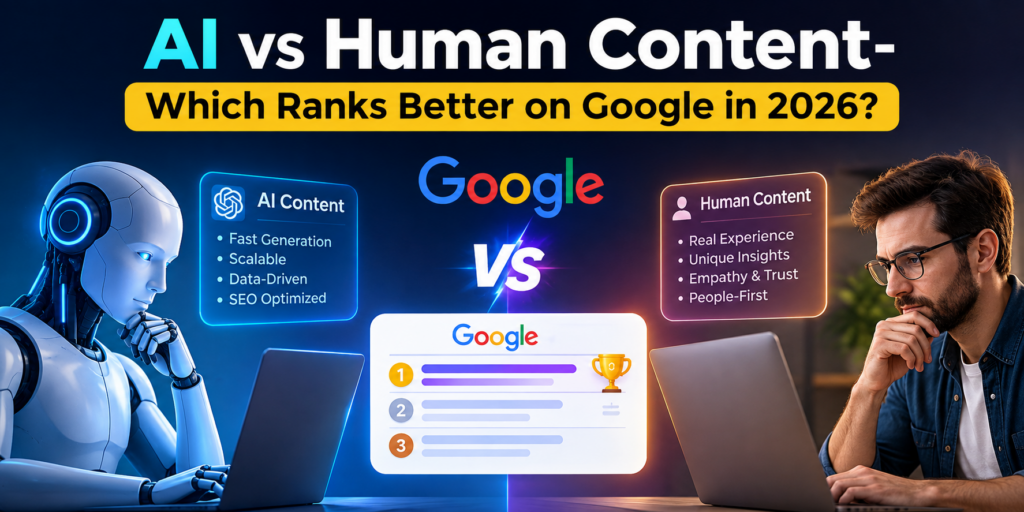
AI vs Human Content- Which Ranks Better on Google in 2026? – Human-written content still ranks better than pure AI content on Google in 2026 -but the gap is smaller than most people assume, and it closes almost entirely once a human meaningfully edits the AI draft.
Multiple large-scale studies published this year converge on the same conclusion: authorship alone isn’t the deciding factor; editorial quality is.
This guide walks through what the actual 2026 ranking data shows, why pure AI content tends to underperform, why AI-assisted content can rank almost as well as fully human writing, and what this means practically for a blogger in the US or an agency in the UK deciding how much AI to lean on in their content workflow.
What the 2026 Data Actually Shows
The debate over AI versus human content used to run almost entirely on opinion. That changed in 2026, as several large studies tracked real ranking outcomes across thousands of pages rather than relying on speculation.
The Ahrefs 150,000-Page Study-Ahrefs
In one of the largest studies published this year, Ahrefs analyzed roughly 150,000 pages ranking in Google’s top ten results. The findings were striking only 5.3% of top-three results were entirely AI-generated, while 82.2% of those top three pages were predominantly human-written, and more than half contained less than 20% AI-generated content.
For anyone who assumed AI had quietly taken over top search results, this data tells a different story the top of Google in 2026 is still overwhelmingly human authored.
The Semrush 8x More Likely Study-Semrush
Separate research from Semrush found that human-written pages were roughly eight times more likely to rank in the number one position compared to AI-generated content.
Interestingly, the same study found a disconnect between perception and reality 72% of SEO professionals surveyed believed AI content performed as well as or better than human content, even though the actual ranking data showed a clear human advantage at the very top of results.
The 16 Month AI vs Human Ranking Study
Perhaps the most detailed dataset came from a 16 month study tracking 4,200 articles across 140 domains, comparing matched pairs of AI-generated and human-written content targeting equivalent keywords.
Pure AI content, published with minimal human intervention, ranked 23% lower on average than human-written articles, with that gap widening after Google’s March 2026 core updates.
But the same study found something equally important AI-drafted content that received substantive human editing, original data, and expert attribution performed within just 4% of fully human-written content on median ranking position.
Real-world example: A UK-based home improvement blog ran its own internal version of this comparison across 30 articles half drafted entirely by AI and published with minimal changes, half drafted by AI and then heavily edited by the site owner with her own project photos and specific cost breakdowns added.
Six months later, the heavily edited batch was ranking on average two full positions higher than the unedited batch for comparable keywords.
Does AI Content Get Fewer Backlinks Than Human Content? (The Backlink Gap)
The 16-month study also identified what it called the single most damaging measurable consequence of unedited AI publishing: AI-only content acquired 61% fewer editorial backlinks than human-written articles on comparable topics.
Since backlinks remain one of Google’s most influential ranking signals, this gap alone can explain much of the long-term performance difference between the two approaches, even when on-page quality looks similar at first glance.
The Rankability AI Detection Study
A separate 2026 analysis from Rankability scored 487 top ranking Google results for competitive commercial keywords using an in-house AI content detector.
Pages were categorized as human-written when their blended AI-probability score fell at or below 30, and AI-generated when it hit 70 or above. The headline finding roughly 83% of the pages they could reliably score read as human-written, reinforcing the pattern seen in the larger Ahrefs study Google’s top results in 2026 remain disproportionately human-authored, even accounting for the study’s smaller, more competitive sample.
The researchers were careful to note this is a directional study with a focused sample rather than a definitive, universal analysis, and that AI detection tools themselves aren’t perfectly accurate.
Still, the consistency across four separate studies using different methodologies Ahrefs, Semrush, the 16 month tracking study, and Rankability makes the overall pattern hard to dismiss as noise.
Real-world example: A SaaS content team in Chicago used a similar AI-detection approach internally to audit their own blog before a planned content refresh, and found that their lowest-traffic articles clustered heavily in the high AI-probability range, while their five highest-traffic posts all scored as clearly human-written prompting them to prioritize rewriting the AI-heavy articles rather than producing new content from scratch.
Does Google Penalize AI-Generated Content?
Google’s own guidance on this topic has been consistent since 2023, and it hasn’t changed materially in 2026 the company rewards high quality, helpful content regardless of how it was produced, and does not apply a blanket penalty simply because AI was involved in writing it.
What Google’s spam policies do target is content created primarily to manipulate rankings including mass-produced, thin AI content published purely to fill pages with keyword matched text rather than to genuinely help a reader.
In practice, this means the “AI vs human” framing is slightly misleading. The more accurate question Google’s systems are actually evaluating is whether a page demonstrates real experience, expertise, and usefulness a standard that poorly written human content can fail just as easily as poorly produced AI content.
Why Does Pure AI Content Rank Lower Than Human Content?
Several consistent patterns explain why unedited AI content tends to rank lower, even when it’s grammatically clean and keyword-optimized on the surface.
Missing Nuance and Context
AI models are strong at pattern-matching language, but they don’t have lived experience. Content that only pulls from general patterns in training data tends to miss the specific, situational nuance that makes a piece genuinely useful the kind of detail someone only knows from having actually done the thing they’re writing about.
Weaker Engagement Signals
Human-written or human-edited content tends to hold reader attention longer, and that shows up in behavioral signals time on page, scroll depth, and return visits that compound over time and appear to help pages stay stable through Google’s core updates, while thinner AI pages are more prone to sudden drops.
Fewer Earned Backlinks
As the 61% backlink gap suggests, other site owners and journalists are simply less likely to cite or link to content that reads as generic. A unique data point, a specific case study, or a strong original opinion earns links in a way that recycled AI summarization rarely does.
Real-world example: A personal finance blogger in Austin noticed her AI-drafted “how to build credit” article sat around position 15 for months despite solid on-page optimization.
After rewriting the introduction to include her own credit-building timeline with actual numbers, and adding a short case study from a reader she’d coached, the article climbed to position 6 within two months the content itself hadn’t changed structurally, but the specific, human detail clearly moved the needle.
Can AI-Assisted Content Rank as Well as Human Content?
The 4% performance gap found in the 16-month study is the detail that matters most for anyone currently deciding how to structure their content process. It suggests the real variable isn’t whether AI touched the draft at all it’s whether a human meaningfully shaped the final version.
Content that performs well in this hybrid category typically shares a few traits: an AI-generated first draft that’s substantially rewritten rather than lightly edited, original data or a personal example added that the AI couldn’t have generated on its own, named expert sources or direct quotes where relevant, and a clear point of view rather than a balanced to the point of generic summary of a topic.
Real-world example: A small marketing agency in Manchester restructured its content process so every AI-drafted article went through a mandatory expertise pass a senior writer added one original insight, one specific client example (anonymized), and rewrote the introduction entirely by hand.
Across 40 articles produced this way over four months, average ranking position was statistically indistinguishable from the agency’s fully human-written control group, while production time dropped by roughly half.
The Real Variable-Editorial Quality, Not Authorship
Independent studies using AI-content detection tools have found broadly similar patterns. One analysis of 487 top ranking pages for competitive commercial keywords found that around 83% scored as predominantly human-written using a blended AI-probability scoring method, reinforcing that Google’s algorithms continue to reward content that reads as clearly human, whatever tool helped produce the first draft.
Put together, the emerging consensus across these separate studies is remarkably consistent: content quality, originality, and demonstrated expertise are the actual ranking factors.
Authorship human or AI is really a proxy for those qualities, not a ranking signal in its own right. That’s why poorly written human content can still fail, and well-edited AI-assisted content can still succeed.
How to Combine AI and Human Writing for Best Rankings
Based on what the current data shows, a practical hybrid workflow looks something like this:
- Use AI for research, outlining, and a first draft this is where AI reliably saves the most time without hurting quality.
- Add at least one piece of original, non-AI-generatable content a personal example, original data, a client case study, or a direct quote from someone with real experience in the topic.
- Rewrite the introduction and conclusion by hand, since these sections carry disproportionate weight for both reader engagement and how AI Overviews tend to extract summary text.
- Fact check every claim, statistic, and quote before publishing, since AI models can occasionally state something confidently that isn’t accurate.
- Vary sentence structure and cut generic transitional phrases during a final editing pass this is often the single fastest way to make AI-assisted content stop reading as AI-assisted.
- Track which of your existing articles are underperforming and audit them for AI-probability signals before assuming the topic itself is the problem as the Chicago SaaS example above shows, a rewrite often outperforms starting a new article from scratch.
None of this requires expensive tooling to get started. A simple content calendar that flags which articles received a full human rewrite versus a light edit, reviewed quarterly against traffic data, is often enough to spot the pattern in your own results without needing a dedicated AI-detection subscription.
How This Fits Into GEO and AI Overviews
The AI vs human question doesn’t only affect traditional search rankings it also shapes whether a page gets cited inside Google’s AI Overviews and chat based answer engines like ChatGPT and Perplexity.
Since these systems are themselves trained to identify and prioritize genuinely useful, well sourced content, the same qualities that help a page rank traditionally original data, clear expertise, and specific detail also tend to improve its odds of being selected as a citation inside an AI-generated answer.
One added wrinkle for Generative Engine Optimization specifically AI systems appear to weight freshness and specificity heavily when choosing which source to cite among several similar-quality pages.
A page with a named case study or a recent statistic has a structural advantage over a more generic, well written but interchangeable summary reinforcing that the add something AI couldn’t generate principle matters just as much for AI search visibility as it does for traditional Google rankings.
How to Tell If Your Own Content Reads Too “AI-Generic”
Before assuming a whole content strategy needs an overhaul, it helps to know the specific signs that tend to separate weak AI-assisted content from strong human edited content, based on the patterns these studies identify:
- No specific numbers or names: generic phrases like many experts agree or studies show without a named source or figure are a common AI tell that also weakens credibility with readers.
- Balanced to the point of saying nothing: content that presents every angle equally without ever landing on a clear recommendation or opinion often reads as AI-generated, since AI models are trained to avoid controversy by default.
- Repetitive sentence structure: long stretches where every sentence follows the same subject verb object rhythm, without variation, is one of the more detectable AI patterns even to casual readers.
- Missing sensory or situational detail: real experience naturally includes specific, sometimes messy detail a wrong turn, an unexpected cost, a surprising result that AI content trained on summarized patterns tends to smooth over entirely.
Real-world example: A travel blogger reviewing her own six-month-old AI-drafted destination guides noticed nearly every article followed an identical five-paragraph rhythm with no first-person detail at all.
After adding one specific, slightly imperfect personal anecdote to each guide’s introduction a delayed flight, a restaurant that turned out to be closed average time on page across those articles increased by nearly 40% within the following month, without any other changes to the content.
Pros and Cons-AI Content vs Human Content
AI Content: Pros
- Speed: a first draft that would take a human writer hours can be produced in minutes, which matters most for high-volume content operations.
- Consistency: AI-generated content SEO structure (headers, keyword placement, formatting) tends to be reliably consistent across a large batch of pages.
- Lower cost at scale: for businesses producing large volumes of similar content types (product descriptions, location pages), AI reduces per-page production cost significantly.
- Good starting point for research and outlining: even critics of pure AI publishing generally agree it’s a strong tool for the drafting and research stage specifically.
AI Content: Cons
- Weaker E-E-A-T signals: unedited AI content struggles to demonstrate the real experience and expertise Google’s quality systems increasingly reward.
- Fewer earned backlinks: as covered above, AI-only content earns meaningfully fewer editorial links than comparable human-written content.
- Generic phrasing and structure: without editing, AI content tends toward repetitive sentence patterns and overly balanced statements that read as impersonal.
- Risk of factual errors: AI models can state incorrect information confidently, making fact checking a non-negotiable step before publishing.
Human Written Content- Pros
- Stronger ranking performance at the top of results: the data consistently shows human-written content dominates the highest-competition positions.
- Genuine expertise and nuance: real experience naturally surfaces the specific, situational detail AI content tends to smooth over.
- Better engagement signals: readers tend to spend more time on and return more often to content that demonstrates a genuine human-written content ranking advantage in trust and voice.
- Stronger long term backlink potential: original, human driven insight is what other sites and journalists tend to cite.
Human Written Content: Cons
- Slower production: a well researched, well written article can take significantly longer to produce than an AI-drafted one.
- Higher cost: skilled human writers command higher per-article rates than AI-assisted production, especially at scale.
- Inconsistent quality across large teams: without a strong editorial process, human-written content quality can vary significantly writer to writer.
- Doesn’t automatically outperform: as the data shows, poorly researched human content can still underperform well-edited AI-assisted content human authorship alone isn’t a quality guarantee.
Common Mistakes Businesses Make With AI Content
Publishing AI Drafts With Zero Editing
The single most common mistake is treating AI output as a finished product. Even strong AI drafts benefit from a human pass that adds specificity and cuts generic phrasing skipping this step is the most direct path to the 23% ranking disadvantage the data shows.
Scaling AI Content Without Scaling Editorial Oversight
Some sites publish dozens of AI articles a week without proportionally increasing editorial review, assuming volume alone will offset quality. Google’s core updates in 2026 have specifically targeted this pattern, penalizing sites that scaled thin content faster than they scaled genuine expertise.
Assuming All Human Content Automatically Outperforms AI Content
The data doesn’t support treating “human-written” as an automatic quality guarantee either. Poorly researched, generic human content underperforms well-edited AI-assisted content in head-to-head comparisons the deciding factor is genuine usefulness, not the method of production.
Frequently Asked Questions
Does Google penalize content just for being written by AI?
No. Google’s official position, unchanged since 2023, is that it rewards helpful, high-quality content regardless of how it was produced. What gets penalized is content created primarily to manipulate rankings, such as mass-produced, thin AI text with no real value to readers.
What percentage of top ranking Google pages are AI-generated?
A large 2026 Ahrefs study of roughly 150,000 top-ten results found only 5.3% of top-three positions were entirely AI-generated, while 82.2% were predominantly human-written, suggesting fully human-authored content still dominates the very top of search results.
Can AI-assisted content rank as well as fully human-written content?
Yes, when it receives substantive human editing. A 16 month study tracking 4,200 articles found AI-drafted content with meaningful human editing, original data, and expert input performed within about 4% of fully human-written content on median ranking position.
Why does pure AI content tend to rank lower than human content?
The gap largely comes down to weaker engagement signals, missing situational nuance that only real experience provides, and significantly fewer earned backlinks one study found AI-only content received 61% fewer editorial backlinks than comparable human-written articles.
Does using AI content hurt visibility in Google’s AI Overviews specifically?
Not inherently, but the same qualities that help traditional rankings original data, specific examples, and clear expertise also appear to improve a page’s odds of being cited inside AI Overviews and other AI-generated answers, so generic, unedited AI content is likely to underperform there as well.
What’s the single most effective way to improve AI-assisted content’s ranking potential?
Adding something the AI genuinely couldn’t have generated on its own a personal example, original data, a direct expert quote, or a specific case study consistently appears as the strongest lever across the available research, more so than any particular editing technique alone.
How can I tell if my own published content is scoring as too AI-generic?
Look for the absence of specific numbers, named sources, or personal detail, along with overly balanced statements that never land on a clear opinion, and repetitive sentence rhythm across paragraphs.
These patterns are consistently associated with weaker-performing AI content across the available 2026 studies, and are usually fixable with targeted edits rather than a full rewrite.
Is AI content bad for SEO?
Not inherently. AI content isn’t automatically bad for SEO the 2026 data shows the real problem is unedited, generic AI content published at scale without genuine expertise added. AI-assisted content that receives substantive human editing performs nearly as well as fully human-written content.
How much AI content is too much on a website?
There’s no official percentage threshold from Google, but studies suggest sites relying heavily on scaled, minimally edited AI content see more ranking volatility during core updates than sites where AI is used as a drafting tool alongside meaningful human editorial oversight.
The safer approach is judging each individual page’s quality rather than tracking an overall site-wide AI percentage.
Will AI content get penalized by Google in 2026?
Google does not penalize content simply for involving AI in its production. It penalizes content created primarily to manipulate search rankings, including thin, mass-produced AI text with little genuine value a distinction based on quality and intent, not the tool used to write it.
Can you tell if content was written by AI just by reading it?
Sometimes. Common signs include repetitive sentence structure, overly balanced statements without a clear point of view, generic phrases like many experts agree without a named source, and a lack of specific, situational detail though dedicated AI detection tools are generally more reliable than reading alone for a confident judgment.
Conclusion
The honest answer to “AI vs human content, which ranks better” is that the format war is largely a distraction from what the 2026 data actually shows editorial quality is the real deciding factor, and it explains both why pure AI content underperforms and why well edited AI-assisted content can rank almost as well as content written entirely by hand. Google isn’t hunting for AI it’s hunting for emptiness, wherever that emptiness comes from.
For most bloggers and businesses, the practical takeaway isn’t to abandon AI or to avoid editing altogether it’s to treat AI as a genuinely useful drafting partner while reserving the parts only a human can provide real experience, original data, and a clear point of view.
That combination, more than any single tool or writing method, is what the data says actually keeps a page ranking through Google’s next update.
also read – ChatGPT vs Gemini vs Claude for SEO: Which AI Wins in 2026?
Best AI SEO Tools in 2026- The Complete Guide


