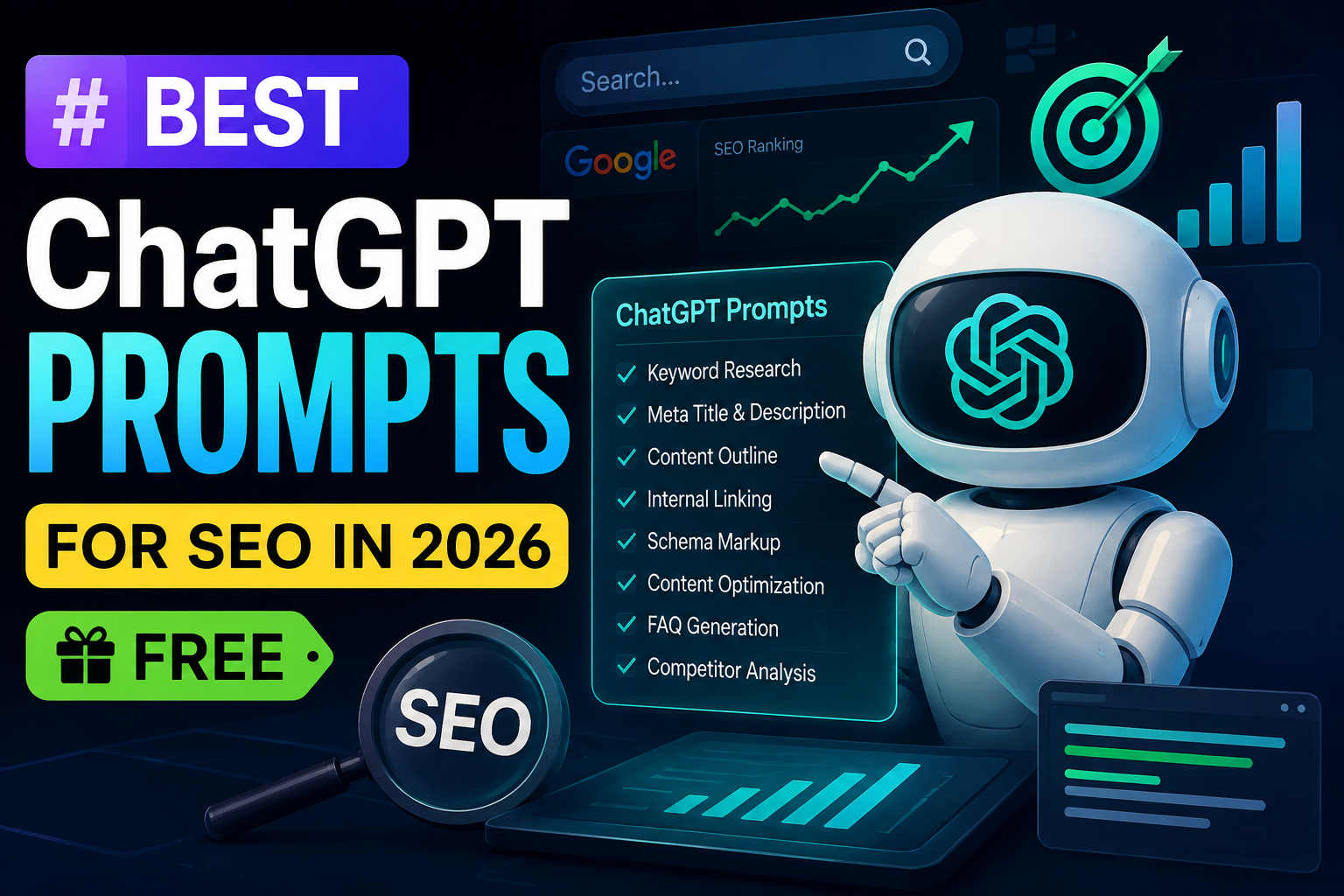
38 Best ChatGPT Prompts for SEO in 2026 Free
The best ChatGPT prompts for SEO cover six core areas- keyword research, content briefs, on-page optimisation, content editing, technical SEO, and competitor analysis and every prompt in this guide is free to copy and use immediately.
What separates a prompt that actually saves time from one that produces generic filler usually comes down to structure naming a role, giving context, stating the exact intent, and specifying the output format ChatGPT should return.
This guide organizes 38 SEO prompts for ChatGPT by task, so you can jump straight to whatever part of your workflow is currently the biggest time sink whether that’s a US based blogger trying to plan a month of content in one sitting, or a UK agency running the same prompts across a dozen client accounts every week.
Why These ChatGPT SEO Prompts Work
Most SEO copywriting prompts that fail do so because they’re too vague write me an SEO article about X gives ChatGPT almost nothing to work with. The prompts in this guide follow a simple four-part structure that consistently produces sharper, more usable output (Chat GPT prompts for content writing)
- Role: tell ChatGPT what kind of expert to act as (Act as an SEO content strategist)
- Context: give it the specific topic, audience, or existing content it’s working from
- Intent: state exactly what you want it to produce or solve
- Output format: specify the format a table, a numbered list, a set of headers so the response is usable without heavy reformatting
A quick reminder before diving In ChatGPT is a strong AI content generation and drafting partner, but it doesn’t have access to live search volume or ranking data.
Every keyword or difficulty claim it makes should still be checked against a real tool like Google Keyword Planner, Ahrefs, or Semrush before you commit to it.
ChatGPT Prompts for Keyword Research
These prompts handle the brainstorming and organizing stage of keyword clustering AI work the part that used to eat the most time before a single word of content got written.
- Act as an SEO keyword researcher. My seed keyword is [topic]. Generate 25 semantic keyword variations covering different phrasings and related concepts.
- Generate 30 long tail keyword variations for [seed keyword] focused on lower competition phrases a small site could realistically rank for.
- Classify these keywords by search intent Informational, Commercial, or Transactional
- Group these keywords into semantic topic clusters and suggest a pillar page title for each cluster
- Generate 20 question based keywords for [topic], starting with how, what, why, should, can, is, and does.
- List 15 related entities and concepts search engines would expect to see covered in a comprehensive article about [topic].
Real-world example: A freelance nutritionist in Denver used prompt #4 on a list of 50 scattered keywords she’d collected over months, and within a minute had them organized into five clear clusters turning a chaotic spreadsheet into a ready made content calendar for the next quarter.
The UK specific bonus prompt matters more than it looks. A generic keyword prompt tends to default toward American spelling and phrasing unless told otherwise, so UK targeted content specifically benefits from stating the region up front rather than editing the spelling afterward.
ChatGPT Prompts for Content Briefs and Outlines
A validated keyword list still needs to become a structured plan before writing starts. These prompts turn research into an outline in minutes.
- Write a detailed SEO content brief for [primary keyword]. Create a full H1–H3 header structure covering the complete search intent, and note which of these keywords fits under each section: [paste keyword list].
- Analyze the search intent behind [keyword] and tell me what content format (guide, listicle, comparison, tool) is most likely to satisfy it.
- suggest 10 subtopics I should cover in an article about [topic] that most existing top-ranking articles are missing.
- Write five alternative headline options for an article targeting [primary keyword], optimized for both click through rate and clarity.
Real world example: A B2B marketing agency in Manchester used prompt #7 on a validated keyword cluster for a client’s employee onboarding software page and had a full eight section outline in under a minute a task that previously took their strategist closer to an hour of manual planning.
ChatGPT Prompts for On-Page SEO
These handle the smaller, repetitive tasks meta titles, descriptions, URLs, and alt text that add up to real time savings across dozens of pages.
- Write 5 SEO optimized meta titles for a page about [topic], each under 60 characters and including the primary keyword [keyword].
- Write 3 meta descriptions under 155 characters for a page about [topic] that include the keyword [keyword] and a clear reason to click.
- Based on this title and primary keyword, suggest a short, SEO friendly URL slug [title] [keyword].
- Write descriptive alt text for these images based on their filenames and this page’s topic [list of filenames], topic.
- Suggest 3 internal linking opportunities for this article based on the topic [topic] and this list of existing pages on my site [paste list].
Real-world example: An e-commerce store owner in Austin used prompt #14 to generate alt text for over 200 product images in a single afternoon, a task that would have taken days of manual entry across that many individual listings.
ChatGPT Prompts for Content Optimization and Editing
Once a draft exists, these SEO content writing AI prompts sharpen it tightening structure, improving readability, and catching gaps before publishing.
- Review this article draft and list any topics a comprehensive guide on [topic] should cover but this draft is missing. Rewrite this paragraph to be clearer and more direct without losing any information
- Check this article for keyword stuffing or unnatural repetition of [keyword]and suggest more natural alternatives where needed: [paste article].
- Rewrite this content in a more NLP friendly way shorter sentences, clearer subject verb object structure, fewer filler words: [paste content].
- Read this draft and flag any sentences that sound generic or AI written, and suggest a more specific, human alternative

Real-world example: A solo blogger in Bristol ran prompt #20 on a first draft she suspected sounded flat, and the output flagged six overly generic sentences rewriting just those sections, rather than the whole piece, cut her editing time roughly in half compared to her usual full read through.
ChatGPT Prompts for Technical SEO
ChatGPT can’t crawl your site, but it’s genuinely useful for explaining fixes, drafting schema, and prioritizing technical issues once you have the raw data.
- Generate FAQPage schema markup in JSON -LD format for these five questions and answers [paste Q&A pairs].
- Explain in plain language what a 301 redirect chain is, why it hurts SEO, and how to identify one in a Screaming Frog crawl export.
- I have this list of Search Console errors [paste list]. Group them by likely cause and suggest which to prioritize fixing first.
- Write a robots.txt file that blocks [folder] from being crawled while still allowing [folder] to be indexed.
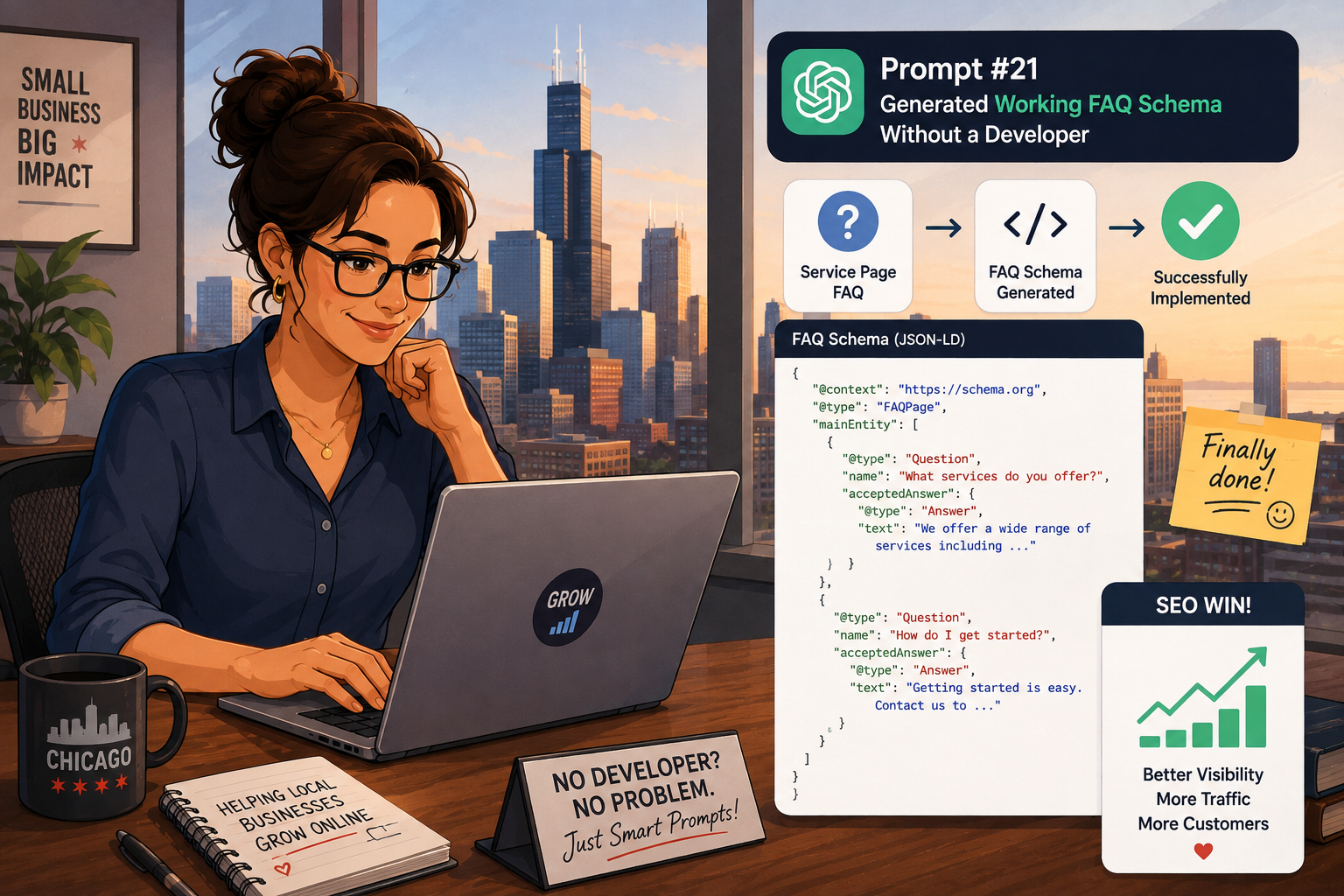
Real world example: A small business owner in Chicago with no developer on staff used prompt #21 to generate working FAQ schema for her service pages, something she’d been avoiding for months because she assumed it required a developer to implement correctly.
ChatGPT Prompts for Competitor Analysis
These prompts help spot gaps and angles competitors have missed, without needing a paid competitive intelligence tool for the first pass.
- Compare these two articles targeting the same keyword [keyword] and tell me what the second one covers that the first is missing [paste article 1], [paste article 2].
- Based on this list of top ranking page titles for [keyword], identify a content angle none of them are currently using [paste titles].
- Summarize the likely target audience and search intent behind these five competing articles based on their titles and structure: [paste list].
Real world example: A UK-based finance blogger used prompt #26 on the top five ranking titles for how to save for a house deposit and noticed every one focused on saving tactics none addressed the emotional stress of the process, which became the unique angle for her next article and its strongest performing section.
ChatGPT Prompts for AI Overview and GEO Visibility
A newer category, built specifically around getting cited inside AI-generated answers rather than just ranking in traditional search results.
- Rewrite this paragraph so the first sentence directly and completely answers the question [question], suitable for an AI Overview or featured snippet [paste paragraph].
- Generate 10 sub questions an AI search engine might break the query [main query] into, so I can make sure my article addresses each one.
- Suggest three places in this article where adding a specific statistic or named source would strengthen its credibility for AI search citation: [paste article].
Real-world example: A software as a service marketer used prompt #28 to restructure an existing FAQ section so each answer led with a direct statement, and several of those questions began appearing in Google’s AI Overview snippet within weeks of the update going live.
Common Mistakes When Using ChatGPT SEO Prompts
Publishing the Raw Output Without an Editing Pass
The prompt is only the first step. Content that goes straight from ChatGPT to your CMS without a human editing pass tends to read as generic, and Google’s 2026 core updates have specifically targeted thin, repetitive content not AI use itself, but the shallow output that unedited AI drafts tend to produce.
Trusting Keyword Volume Claims Without Validation
ChatGPT can suggest a keyword sounds high volume, but that’s a language pattern, not real search data. Every specific volume or difficulty claim needs checking against an actual tool before it shapes a content decision.
Using the Same Generic Prompt for Every Client or Niche
A prompt with no specific context about audience, geography, or existing content produces generic results regardless of how well structured it is. Adding two or three sentences of real context before the actual request noticeably sharpens what comes back.
Skipping the Human Editing Pass Entirely
Even a well structured prompt gives you a first draft, not a finished piece. A quick pass to cut stiff transitional phrases, vary sentence length, and add one genuine personal detail or example tends to make the difference between content that reads as competent and content that reads as genuinely useful the distinction that increasingly separates ranking content from content that gets buried after a core update.
How to Combine These Prompts With Real SEO Tools
The prompts above work best paired with a free or paid data source at the validation stage, rather than used entirely on their own. A practical sequence many bloggers and small teams follow run the keyword research prompts first, then check the strongest candidates in Google Keyword Planner or a free tool like Ubersuggest before writing anything.
Once a topic is confirmed, the content brief prompts turn that validated keyword into an outline, and the on-page prompts handle the smaller elements meta titles, descriptions, alt text once the draft is finished.
Real-world example: A part time blogger in Leeds used to spend nearly her entire Sunday on keyword research and outlining before writing a single word. After building this exact prompt then validate workflow ChatGPT for ideation, a free keyword checker for validation, ChatGPT again for the outline she cut that same process down to under an hour, leaving most of her Sunday for the actual writing.
Frequently Asked Questions For 38 Best ChatGPT Prompts for SEO in 2026 Free
Are these ChatGPT SEO prompts really free to use?
Yes. Every prompt in this guide works on ChatGPT’s free tier, which is sufficient for the keyword research, content brief, and on-page SEO tasks covered here. No paid plan or subscription is required to use any of the 50 prompts.
Can ChatGPT replace a real SEO tool like Ahrefs or Semrush?
No. ChatGPT is excellent for brainstorming, clustering, and drafting, but it can’t access live search volume, backlink data, or ranking difficulty. The most effective workflow uses ChatGPT for ideation and a dedicated SEO tool to validate the results with real data.
Does using ChatGPT prompts for content hurt Google rankings?
Google has stated it doesn’t penalize content simply for being created with AI assistance. What it does penalize is thin, unhelpful, or repetitive content, regardless of how it was produce which is why the editing and fact-checking step after using these prompts matters as much as the prompts themselves.
Which ChatGPT model is best for SEO prompts?
More capable models generally handle complex, multi-step SEO prompts more reliably and follow detailed formatting instructions more accurately, which matters for tasks like full content briefs.
Lighter, faster models are usually sufficient for simpler tasks like generating meta descriptions or alt text at scale.
How many of these prompts should I use for a single blog post?
A typical single article workflow uses four to six prompts: one or two for keyword research, one for the content brief, one or two for on-page elements like meta titles and descriptions, and one for a final editing pass rather than all 38 at once.
Can these prompts help my content get cited in Google’s AI Overviews?
The AI Overview and GEO specific prompts in this guide are built exactly for that structuring answers to directly address a question in the first sentence, covering related sub questions, and adding specific statistics tend to improve the odds of citation, though no prompt can guarantee it.
Do these prompts work the same way for a UK audience as a US audience?
Mostly, though word choice and spelling can drift toward American English by default unless a prompt specifies otherwise. For UK-targeted content, adding a short instruction like using British English and UK specific examples to any of these prompts produces a noticeably more accurate result than leaving the region unspecified.
What’s the biggest timesaver among these 38 prompts for someone just starting out?
For most beginners, the content brief prompt (#7) tends to save the most relative time, since turning a keyword list into a structured outline is usually the slowest manual step in the entire content process, and getting a workable draft outline in under a minute changes that math significantly.
Download free SEO Prompt Quick Sheet
Conclusion
ChatGPT prompts won’t replace SEO strategy, and none of the 38 above are trying to. What they do is remove the repetitive, time consuming steps brainstorming, outlining, drafting meta tags, spotting content gaps that used to eat hours before the real work of writing and refining even started.
Used with a real data source for validation and a genuine editing pass before publishing, this prompt library can realistically save several hours a week for anyone doing SEO content work regularly.
Start with whichever section matches your current biggest bottleneck. If keyword research is the slowest part of your process, begin there. If it’s turning a keyword list into an actual outline, jump to the content brief prompts.
Small, consistent use across a few weeks tends to reveal far more about how these prompts fit your workflow than reading through all 38 in one sitting ever will. Bookmark this page and return to the specific section you need that’s a more realistic way to build these into a habit than trying to memorize the entire list at once.
Also Read –Best AI SEO Tools in 2026- The Complete Guide
How AI Is Transforming Email Marketing | Best AI Tools for Email Marketing (Full Guide)