


Becoming a PPC expert in 2026 generally takes 6 to 12 months of consistent, hands-on learning, starting with Google Ads fundamentals, running small real or demo campaigns, earning a certification or two, and building a portfolio that shows actual results rather than just theory.
It’s one of the more accessible digital marketing careers to break into, since it requires no coding background and no formal degree, though it does require the discipline to keep learning as platforms and AI driven automation continue reshaping what the job actually involves.
This guide lays out a realistic, step-by-step path from complete beginner to a hireable PPC specialist, what certifications are actually worth your time, how much the role pays as you advance, and how AI is changing what “expert” means in this field in 2026.
What Is PPC, and What Are the Main Types of PPC Ads?
PPC, or pay-per-click advertising, is a model where an advertiser pays a fee each time someone clicks their ad, rather than paying a flat rate for placement regardless of engagement. As a PPC expert would put it . it’s less like renting a billboard and more like a toll booth you only pay when someone actually walks through.
Understanding the main ad types is the first real skill in this field, since choosing the wrong format for a given goal is one of the most common reasons early campaigns underperform.
Search Ads
Search ads appear directly in search engine results when someone types a query with clear intent think the text ads at the top of a Google search. These capture demand that already exists, since the person is actively looking for something, which is why search typically commands the highest cost-per-click of any format (averaging around $5.26 across industries) but also converts at a higher rate than most other types.
Display Ads
Display ads are the banner-style image and text ads shown across a network of websites, rather than inside search results. They’re built for building awareness at a low cost rather than capturing someone already searching, making them useful earlier in a customer’s decision process, before demand has fully formed.
Shopping Ads
Shopping ads show a product image, price, and store name directly inside search results, pulled from a product feed rather than written manually like a text ad. For e-commerce specifically, these tend to convert exceptionally well, since a shopper can compare options visually before ever clicking through.
Video Ads
Video ads run primarily on YouTube and similar platforms, in formats like in-stream (playing before or during other video content) and in-feed placements. Video’s share of total ad spend has grown substantially, and platforms increasingly reward vertical, short-form, authentic-feeling video over polished but static creative.
Social Media (Paid Social) Ads
Platforms like Facebook, Instagram, LinkedIn, and TikTok offer PPC ad formats targeted by demographics, interests, and behavior rather than search intent. LinkedIn in particular is favored for B2B targeting by job title and company, while Instagram and TikTok suit visually driven consumer products.
Remarketing (Retargeting) Ads
Remarketing shows ads specifically to people who’ve already visited a website or interacted with a brand, whether or not they made a purchase. Because the audience already has some familiarity with the product, remarketing tends to produce higher conversion rates than cold targeting, and it plays a distinct role in the funnel closing out visitors who were close to converting but left before finishing.
Performance Max
Performance Max is Google’s automated, goal-based campaign type that serves ads across nearly all of Google’s inventory Search, Display, YouTube, Discover, Gmail, and Maps from a single campaign, using machine learning to optimize placement and bidding in real time. It’s become a dominant format, but most experienced PPC specialists run it alongside, not instead of, a dedicated Search campaign, since Performance Max’s reporting doesn’t offer the same product-level or keyword-level visibility a standalone campaign provides.
Demand Gen and App Ads
Demand Gen is a newer campaign type designed to reach people before search intent has fully formed, typically at a considerably lower cost-per-click than Search useful for building a pipeline of future demand rather than capturing existing demand. App campaigns, meanwhile, are built specifically to drive app installs and in-app actions across Search, YouTube, the Play Store, and Display with minimal manual setup.
A PPC expert rarely relies on just one of these formats. Most effective strategies deliberately combine several a user might first see a display ad, later search the brand by name, and then receive a remarketing ad before finally converting with each format playing a distinct, complementary role rather than competing for the same job.
What Does a PPC Expert Actually Do?
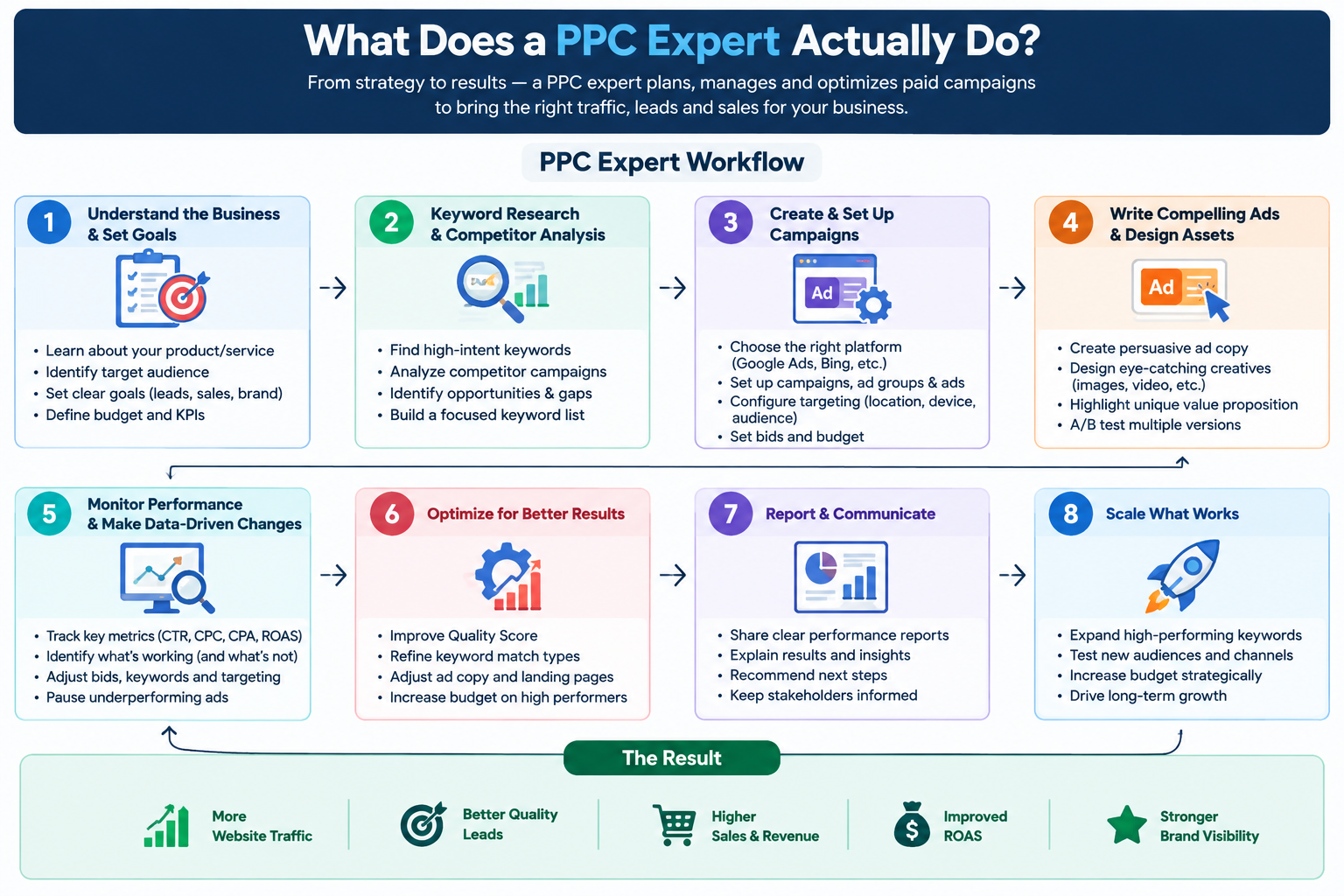
A PPC specialist manages paid advertising campaigns across platforms like Google Ads, Microsoft Ads, Meta, and increasingly TikTok and native ad networks, with the core goal of generating leads, sales, or other measurable outcomes at the lowest reasonable cost.
The day to day work involves setting up and structuring campaigns, writing and testing ad copy, managing bids and budgets, analyzing performance data, and continuously adjusting strategy based on what the numbers show.
It’s a role that lives heavily in data pulling reports, spotting anomalies, and forming testable hypotheses are as central to the job as the ad platforms themselves.

Step-by-Step: How to Become a PPC Expert
Step 1: Learn the Fundamentals
Start with core terminology and concepts before touching any platform seriously: cost-per-click, quality score, campaign types (Search, Display, Shopping, Video), audience targeting, and conversion tracking. Google’s free Skillshop courses are the standard entry point, and they’re genuinely built for someone starting with zero background.
Step 2: Get Hands-On With a Real (or Demo) Account
Reading about PPC and actually running a campaign are very different experiences. Google offers promotional credits for new accounts specifically to lower this barrier, and a small personal budget of $50-100 spent on a real campaign even a simple one promoting a personal project or a friend’s small business teaches more about bidding behavior and optimization than any amount of passive reading.
Step 3: Earn a Foundational Certification
A Google Ads certification (Search, Display, or Shopping) demonstrates baseline competency to employers and costs nothing beyond study time.
It won’t replace real experience, but it signals that you’ve at least covered the fundamentals in a structured way, which matters when you have no work history to point to yet.
Step 4: Build a Portfolio That Shows Real Numbers
Document every campaign you run, even small ones the goal you set, the strategy you used, and the actual results, good or bad. A simple portfolio with real screenshots and specific numbers is significantly more persuasive to a hiring manager than a certification alone, since it shows you can apply what you learned rather than just pass a test.
Step 5: Land Your First Role or Freelance Client
Entry level PPC roles typically look for 1-3 years of experience for supervised campaign execution work, which can feel a total beginner.
In practice, many people break in through adjacent roles first a digital marketing assistant or social media coordinator position that offers exposure to a company’s broader digital operations or by taking on a small freelance client willing to work with someone building their first real portfolio.
You can use Canva’s free plan to create a professional portfolio. it’s a great tool for beginners, and its also useful for creating resumes, free templates and more.
Step 6: Specialize and Advance
Once you have a year or two of solid experience, the field naturally branches into a few specialized tracks technical (deep platform and automation expertise), strategic (budget and cross channel planning), analytics focused (heavy reporting and attribution work), client-facing (agency account management), and e-commerce-specific PPC.
Picking a track to lean into tends to accelerate advancement more than staying a generalist indefinitely.
Which Certifications Are Worth Getting?
Not every certification carries equal weight, and it’s worth being selective rather than collecting badges for their own sake. The certifications most consistently recognized by employers and agencies include:
- Google Ads certifications (Search, Display, Shopping, Video) -the most widely expected baseline credential in the industry.
- Meta Blueprint Certification -Meta’s official certification covering Facebook, Instagram, and Messenger advertising.
- Microsoft Advertising Certification- increasingly relevant as more mid-level and senior roles expect Microsoft Ads experience alongside Google and Meta.
- HubSpot’s Digital Advertising Certification -a solid free option covering paid media strategy and audience targeting more broadly.
Beyond platform-specific certifications, broader digital marketing certificates like the Digital Marketing Institute’s Certified Digital Marketing Professional or Expert tracks can help candidates coming from a completely unrelated background establish credibility, though they matter less once you have actual campaign results to show.
Self Learning vs Structured Courses-Which Path Should You Take?
Both paths genuinely work, and the right choice depends more on your existing background and learning style than on which path is objectively “better.” Self-learning through free platform resources and hands on practice tends to suit people who already have some marketing background and learn well through trial and error, and it costs very little beyond time and a small ad budget for practice campaigns.
A structured course makes more sense for someone starting completely fresh who wants an organized curriculum, mentorship, and often direct exposure to real client projects advantages that can meaningfully shorten the time to a first job, particularly for a career changer without an existing professional network in marketing.
What Skills Do You Need Beyond Platform Knowledge?
Platform expertise gets you in the door, but a handful of surrounding skills separate a mediocre PPC hire from a genuinely strong one:
- Data analysis: comfort in Excel or Google Sheets is close to non-negotiable, and many roles now expect familiarity building dashboards in tools like Looker Studio.
- Copywriting: ad copy that actually converts requires understanding audience psychology, not just fitting text into a character limit.
- Basic tracking and tagging knowledge: no coding is required for most PPC roles, but understanding how conversion tracking and tags work under the hood helps diagnose problems that pure platform knowledge can’t explain.
- Communication: especially in client-facing or agency roles, translating campaign performance into plain language for a non-technical stakeholder is a skill in its own right.
How Much Does a PPC Expert Earn?
Compensation in this field climbs meaningfully with experience and specialization. Entry-level PPC specialists typically start around $50,000-$79,800 in the US, with progression through PPC Executive roles ($63,000-$85,000) and PPC Manager positions ($55,750-$100,000, with wide variation depending on team size and scope).
PPC Consultants, often working independently or in senior agency roles, tend to earn $89,000-$107,000 or more, and the ceiling extends further still experienced specialists who move into VP of Marketing roles have reported compensation in the $125,000-$212,500 range, reflecting the shift from hands on execution to broader strategic responsibility.
Different Career Tracks Within PPC
As the field has matured, PPC careers have branched into more specialized paths rather than staying a single generalist role:
- Technical PPC Specialist: deep expertise in platform mechanics, automation, and increasingly AI-driven bidding systems.
- Strategic PPC Specialist: focused on budget allocation, cross-channel planning, and aligning paid media with broader business goals.
- Analytics-Focused PPC Specialist: heavy on attribution modeling, reporting infrastructure, and translating data into actionable recommendations.
- Client-Facing PPC Specialist: common in agency settings, blending campaign management with account management and client communication.
- E-commerce PPC Specialist: specialized in Shopping campaigns, product feed optimization, and the specific metrics that matter for online retail.
How Long Does It Realistically Take?
Most dedicated learners can land a first PPC role within 6 to 12 months of consistent effort, though this varies based on prior marketing experience and how much time you can commit weekly.
A steady pace of a couple of focused hours a day tends to produce better retention and stronger practical skills than occasional weekend cramming sessions, since PPC is a field where consistent, hands-on practice matters more than passive study volume.
How AI Is Changing What It Means to Be a PPC Expert
Automated and AI-driven bidding has taken over much of the manual bid adjustment that used to define entry level PPC work, which has shifted what “expertise” actually means in 2026. Rather than manually tweaking bids, today’s PPC specialists spend more time on campaign strategy, creative testing, audience and offer structuring, and interpreting what an AI bidding system is optimizing toward then correcting it when the automation optimizes for the wrong signal.
This shift has, if anything, raised the ceiling on what separates a strong PPC expert from a mediocre one, since the purely mechanical parts of the job are increasingly handled by the platforms themselves, leaving strategic judgment as the more valuable and harder-to-automate skill.
A Realistic Weekly Study Plan for Beginners
Rather than treating learn PPC as one large, undefined task, breaking the first 90 days into a specific weekly structure tends to produce faster, more durable progress:
- Weeks 1-2: complete Google’s Skillshop fundamentals courses and learn core terminology cost-per-click, quality score, campaign types, and basic conversion tracking concepts.
- Weeks 3-4: set up a Google Ads account using promotional credit, and launch a first small search campaign, even for a personal project or a low-stakes test product.
- Weeks 5-8: actively manage that campaign testing ad copy variations, adjusting keywords, and tracking what changes actually move performance while studying for a Google Ads certification in parallel.
- Weeks 9-12: document the campaign as a portfolio case study, expand into a second platform (typically Meta Ads), and begin applying for entry-level roles or reaching out to potential freelance clients.
This pace assumes a modest, consistent time investment roughly an hour or two most days rather than an intensive full time bootcamp schedule, and lines up with the broader 6-12 month timeline most beginners realistically need to reach their first paid role.
How to Get Your First Client or Employer to Take a Chance on You
The entry-level needing experience to get a job that requires experience is real, but a few approaches consistently work around it. Offering to manage a small campaign for a local business or a friend’s side project at a reduced rate, or even free in exchange for a documented case study and a testimonial, is one of the most common ways beginners generate their first real portfolio piece.
Freelance platforms with lower barriers to entry can also provide a first paid engagement, even at modest rates, that then becomes the foundation for a stronger portfolio and better paying work afterward.
Internally at companies, roles like marketing coordinator or social media assistant often provide exposure to paid advertising as part of a broader responsibility set, which can be a practical stepping stone into a dedicated PPC role once foundational skills are visible on the job.
Pros and Cons of a PPC Career
Pros
- Low barrier to entry: no coding background, and often no specific degree, is required to start learning and practicing.
- Strong earning potential: clear salary progression from entrylevel roles into six-figure strategic and consulting positions.
- High demand and job security: as long as businesses want online visibility, they need people who can manage ad budgets effectively, making this a stable, growing field.
- Flexibility: PPC work is well suited to freelancing, agency employment, or in house roles, and much of it can be done remotely.
Cons
- Work-life balance can be inconsistent: particularly in agency settings, where multiple client accounts and reporting deadlines can create real pressure.
- Requires continuous learning: platform algorithms and best practices change often enough that stagnating for even a year or two can leave skills noticeably out of date.
- Entry-level : many junior roles technically ask for prior experience, which can make the very first job the hardest one to land.
- Results are highly visible and attributable: unlike some marketing roles where impact is harder to measure, PPC performance is tracked in real time, which means underperformance is also immediately visible to stakeholders.
Common Mistakes Beginners Make Trying to Break Into PPC
Only Studying Theory Without Running Real Campaigns
Certifications and courses build a foundation, but PPC is fundamentally a practical skill. Beginners who skip hands on practice with real or demo budgets tend to struggle in interviews when asked specific, scenario-based questions about actual campaign decisions.
Collecting Certifications Instead of Building a Portfolio
A stack of certificates with no documented campaign results is a weaker signal to employers than a smaller number of certifications paired with two or three well documented campaigns showing real goals, strategy, and outcomes.
Trying to Learn Every Platform at Once
Spreading initial learning across Google Ads, Meta, Microsoft Ads, and TikTok simultaneously tends to produce shallow knowledge of all of them rather than genuine competence in one. Building deep confidence in a single platform, usually Google Ads, before expanding tends to produce a stronger foundation faster.
Frequently Asked Questions about How to Become a PPC Expert in 2026
How long does it take to become a PPC expert?
Most dedicated learners can land their first PPC role within 6 to 12 months of consistent study and hands-on practice, though this varies based on prior marketing background and how much time is invested weekly.
Do I need a degree to become a PPC expert?
No formal degree is strictly required, though many job postings list a bachelor’s degree in marketing or business as preferred. Demonstrated skills, certifications, and a strong portfolio can substitute for formal education in many hiring situations, particularly for freelance or smaller agency roles.
Which certification should I get first as a beginner?
A Google Ads Search certification is generally the strongest starting point, since it’s the most widely recognized baseline credential and covers concepts that transfer to other platforms once you expand into Meta or Microsoft Ads.
Can I become a PPC expert without spending money on ads?
To an extent. Google and Meta both offer demo accounts and free learning resources that simulate campaign management. That said, running even a small real campaign with a modest budget teaches nuances that simulations alone typically don’t capture.
Is coding required to work in PPC?
No, coding is not required for most PPC roles. Basic familiarity with tracking codes and tags is useful for diagnosing measurement issues, but the platforms themselves are designed to be used without programming knowledge.
What’s the difference between a PPC specialist and a PPC manager?
A PPC specialist typically focuses on hands-on campaign execution setup, optimization, and reporting while a PPC manager oversees broader strategy, budget allocation, and often manages a team of specialists across multiple accounts or channels.
Is PPC a good career choice given how much AI is automating in advertising?
Yes, though the nature of the work is shifting. AI has automated much of the manual bidding and optimization that used to define entry-level PPC work, which has increased the relative importance of strategic thinking, creative testing, and interpreting what automated systems are optimizing toward skills that remain valuable precisely because they’re harder to automate.
Should I specialize in one platform or learn multiple platforms as a beginner?
Building deep competence in one platform, typically Google Ads, before expanding tends to produce stronger foundational skills than spreading attention across Google, Meta, Microsoft, and TikTok simultaneously. Once confident in one platform, adding a second becomes considerably faster since many core concepts transfer.
Can I become a PPC expert through freelancing instead of a traditional job?
Yes, and many PPC professionals build their entire career this way. Freelancing offers a practical path around the entry-level experience since smaller clients are often more willing to take a chance on a beginner at a lower rate, which then becomes the foundation for a stronger portfolio and higher-paying work over time.
Related Reading
If you’re building PPC skills to eventually work with clients, our guide on How to Rank Website with SEO ?Complete Information
Free PPC Learning Bonus
Starting your PPC journey? Download our free guide:
5 Free Resources to Start Learning PPC Today Download
Inside, you’ll get:
✓ Free PPC learning resources
✓ A 30-day practice roadmap
✓ PPC campaign checklist
✓ Beginner portfolio-building ideas.
Conclusion
Becoming a PPC expert in 2026 is one of the more realistic career pivots in digital marketing, requiring no coding background, no mandatory degree, and a genuine path from complete beginner to a hireable specialist within 6 to 12 months of consistent effort. The path is straightforward on paper learn the fundamentals, get certified, practice with real campaigns, build a portfolio, and land that first role but the beginners who succeed fastest are the ones who prioritize hands-on practice over passive study and resist the urge to spread themselves across every platform at once.
As AI continues to absorb the mechanical parts of the job, the specialists who thrive won’t be the ones who know how to manually adjust a bid they’ll be the ones who understand strategy, creative testing, and how to work alongside automated systems rather than being replaced by them.
Start with one platform, run real campaigns even at a small budget, and let the portfolio you build do more of the talking than any certificate alone.
also read –Best AI Marketing Tools for Startups in 2026
Best AI Assistant for Small Business in 2026 (8 Tools Compared)


